Hopp til innhold

Norsk nettbutikk | Rask levering | Frakt i hele Norge

Analog Signalbehandling

Utforsk analog signalbehandling som gir varme, karakter og kontroll. Perfekt for miksing, mastering og kreativ lydforming.

API Select SR24 EQ ...

15.295,-

17.295,-

The API Select SR24 2 Channel 4 Band EQ   The SR24 is a two channel, four band equalizer in a two rack space chassis. With a dedicated knob and/or switch for each control function, the SR24 is easy to use; by utilizing continuously variable controls for both the frequency and boost/cut, the SR24 can be very precise in applying equalization to the selected audio material. The SR24 circuit design is deeply rooted in API’s history. From the late 1970’s to the early 1980’s, an audio company called “APSI” manufactured consoles and equalizers. Their 562 module was a 4-band, fully parametric equalizer which was designed by APSI and sold through API.  Over the last several decades, these EQ modules remained a favorite among many studio engineers, but have become increasingly difficult to find. The SR24 is a faithfully re- engineered version of the original 562, offering the user 2 channels of classic analog EQ in one rackmount unit. Features 4 bands of equalization modelled after the classic APSI model 562 EQ Each band offers continuously variable control of frequency and gain, using separate knobs? 12 dB of boost/cut per band All 4 bands are peak/dipping parametric configuration Custom transformer balanced output Fully balanced ¼” and XLR input and output Massive headroom +24 dB clip level   TECHNICAL SPECIFICATIONS -SR24   Inputs: Balanced XLR and 1/4" parallel jacks Outputs: Transformer Bakanced XLR 1/4" parallel jacks (All measurements with 600 Ohm output load) Input Impedance: 12k Ohms Output Impedance: 300 Ohms transformer Balanced Bandwidth: +/- 0.5db, 20Hz - 20kHz THD+N @ 1kHz, +4dbu: 0.01% Maximum Level: +23dbu Signal-to-Noise Ratio: -100db EQ Band: 4 Bands, all +/-12db Peak/Dip type Lo: 20Hz - 200Hz Lo-Mid: 100Hz - 1kHz Hi-Mid: 500Hz - 5kHz Hi: 2kHz - 20kHz Power consumption: 10 Watts   Dimensions: 2U EIA 19" Rack Height: 3.5 Inches Width: 19 Inches  Depth: 10 Inches Weight: 13 lbs
Black Box Analog Design HG-2

48.400,-

57.900,-

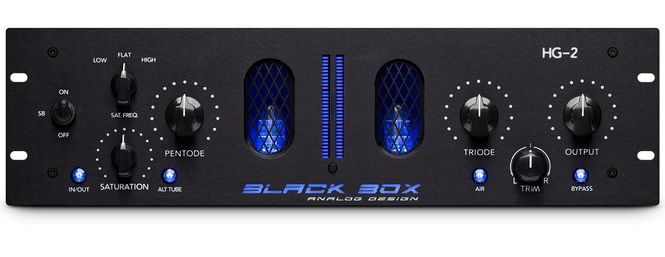
  MIX BUS, MEET YOUR NEW BEST FRIEND. The Black Box Analog Design HG-2 is a line level, stereo unit designed to add saturation, harmonics, natural compression, increased RMS and enhancement during mixing and mastering. It is designed to easily and naturally do what usually requires multiple pieces of gear and do it better! Tubes, transformers & tone! The HG-2 uses custom input transformers to feed two paths: The main signal path travels through a 6U8A Pentode tube stage that then drives into the Triode stage that follows, resulting in everything from subtle harmonics to full on saturation. Also fed from the input transformer is a parallel signal path that utilizes a set of 12AT7 tubes, voiced specifically for harmonics and saturation. This parallel saturation circuit is outfitted with a 3 way “Freq. Select” switch that allows the user to choose the frequency content returning from the circuit. The “low position saturates just the low mids and sub frequencies, the “flat” position saturates full bandwidth and the “high” position saturates only the high mids and high frequencies. The result is the ability to add top end to dull tracks, enhance low end or enhance and add energy to the entire signal. The “saturation” knob allows the user to control how much of the processed, parallel signal is fed into the main signal before hitting the Pentode stage. Finally, both stages reach the passive output attenuation before a pair of custom output transformers. In addition to the saturation stages, an “air” switch adds a subtle top end lift and the “alt” tube button switches between two different 12AT7 tubes in the parallel circuit. Switching between tubes allows the user to select between differently voiced tubes for different types of saturation, instantly. The meter button switches between 3 modes (VU, VU/Peak & Energy), and the “bypass” switch is a true bypass that shorts the input directly to the output with no additional circuitry in line.     Features: High voltage Pentode & Triode tube stages Parallel saturation with mix control Selectable parallel saturation frequency Instantly selectable saturation tubes “Air” lift Ultra fine L/R trim adjust Custom input and output transformers True bypass Selectable 30 segment meter (3 modes) Illuminated push buttons & sealed relays Internally modular design for easy servicing
Black Lion Audio Bluey 500 ...

8.295,-

9.495,-

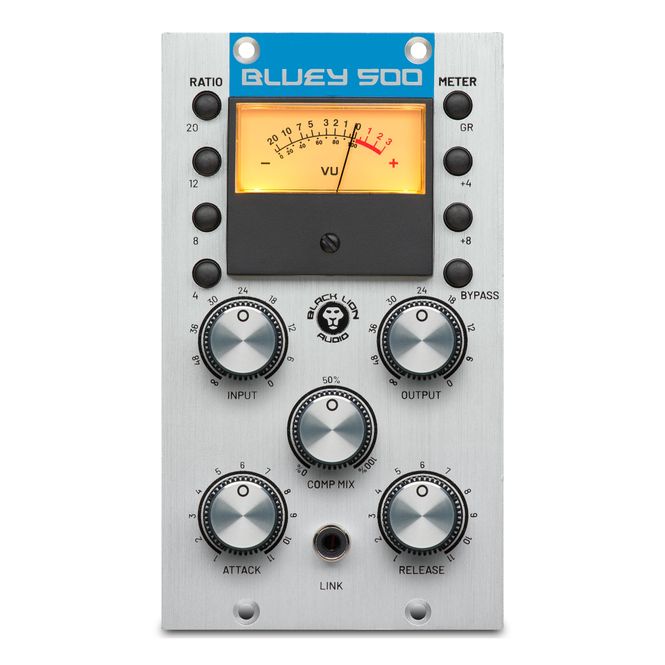
  Bluey 500 is the 500-series version of the lauded Black Lion Audio Bluey. The original “Bluey” is Chris Lord-Alge’s not-so-secret weapon; the heavily-modified 2U compressor to the stars that’s been heard on countless hits. Having undergone years of odd fixes, modifications, and upgrades, the original Bluey was a singular and unique piece of studio unobtainium — until Black Lion Audio got their mitts and voltmeters on it. After working with Chris to reverse-engineer untold years’ worth of mods, component replacements, and upgrades, Black Lion Audio was able to make the legendary Bluey sound available to the world with the introduction of the original 2U Bluey compressor. Of course, they added a few features along the way without sacrificing what makes Bluey what it is. Black Lion firmly believe that everybody deserves a li’l Bluey in their life, so they’re proud to bring the world another li’l Bluey — the Bluey 500 — ready to add that unmistakable blue-striped mojo to your 500-series rack. You get all the squeeze, heft, and grit of the original Bluey in just two 500-series slots — a fraction of the original’s footprint.
Black Lion Audio Seventeen ...

7.495,-

7.995,-

    Black Lion didn’t sacrifice one ounce of tone when they shrunk down their classic Seventeen compressor to fit into the portable 500-series format. Seventeen, for those who don’t already know, is Black Lion’s unique take on what the classic ‘76 limiting amplifier could have been with the benefit of today’s tech. It’s not your grandpa’s ‘76. Seventeen 500 delivers profound detail and nuance never before heard with a ‘76-style compressor. And you even get some features not even available on the originals, including wet/dry mix control, a stereo-link option, and a frequency-adjustable sidechain high-pass filter.
BM 176 Classic VariMu ...

18.995,-

BM 176 Classic VariMu Compressor   The BMA BM176 is a high-quality, tube-based vari-mu compressor derived from the classic 1960s design. Designed to deliver smooth, musical dynamic control in professional recording environments, it is built with a focus on warmth and responsiveness. The BM176 gently shapes transients and adds harmonic richness, preserving the natural character of the source while enhancing its presence. A classic Re-Imagined; the BM176 takes the iconic vari-mu compression concept further with carefully selected components and precise control, offering both subtle leveling and more pronounced dynamic shaping. Its versatile response makes it ideal for mixing, mastering, and tracking applications, whether you're adding cohesion to a bus or bringing vocals and instruments forward with vintage character.     Input Impedance: 600Ω • Output Impedance: 600Ω • Frequency Response: 30Hz–20kHz ±0.5dB • Gain: 35 dB • THD: < 1% • Power Supply: 230V / 115V (switchable) • Power Consumption: 55W Operating Conditions: • Temperature range: 10°C to 35°C • Humidity range: 30% to 70% RH   Fully balanced signal path Custom transformers – Made in-house Neutrik connectors High-quality components 30 dB gain 21-position stepped attenuators, 2 dB per step Input/output Verniers Hi-Z direct input for instruments Interstage transformer Tube anode voltage rectifier Sidechain HPF 115–230 V voltage selector Handmade in EU     ■ 40 Years of Experience   The philosophy behind BMA is simple: to create classic analog equipment that brings musicality, depth and character to any genre, style or production. With a meticulous attention to detail and a no-compromise approach to design, from circuitry to component selection, every product is built to deliver true boutique quality at a level rarely found in this category. Each stage of development and manufacturing is handled with consistency and care, ensuring the original vision is preserved in every unit. ■ Produced in EU   With production based in the EU, BMA maintains full control over quality at every stage. Each unit is built using carefully selected, high-grade components, alongside in-house manufactured elements such as custom transformers, resulting in a consistent standard of build and performance that combines the depth, warmth and character of vintage equipment with the reliability and stability required in modern production environments.
BM PEQ-15M Classic Parametric ...

21.995,-

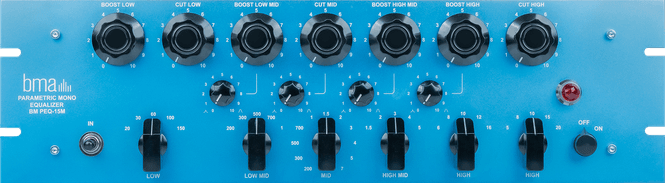
  BM PEQ-15M Classic Parametric Mono Equalizer   The BMA BM PEQ-15M is a high-quality, tube based parametric equalizer designed for precise and musical sound shaping in professional recording environments. Built with a focus on clarity and control, the PEQ-15M allows you to both boost and cut frequencies with accuracy, without compromising the natural character of the source. Two-in-one design; the BM PEQ-15M goes a step further by incorporating additional mid bands for increased flexibility, making this classic-style equalizer even more versatile. perfect for mixing, mastering, and tracking applications.   Input Impedance: 600Ω Output Impedance: 600Ω Frequency Response: 30Hz–20kHz ±0.5dB Gain: 35 dB THD: < 1% Power Supply: 230V / 115V (switchable) Power Consumption: 55W Operating Conditions: Temperature range: 10°C to 35°C Humidity range: 30% to 70% RH           Classic EQP and MEQ combination Custom transformers – Made in-house Neutrik connectors High-quality components Class A buffer amplifier Fully passive EQ circuit Custom inductors 115–230 V voltage selector Handmade in EU   ■ 40 Years of Experience   The philosophy behind BMA is simple: to create classic analog equipment that brings musicality, depth and character to any genre, style or production. With a meticulous attention to detail and a no-compromise approach to design, from circuitry to component selection, every product is built to deliver true boutique quality at a level rarely found in this category. Each stage of development and manufacturing is handled with consistency and care, ensuring the original vision is preserved in every unit. ■ Produced in EU   With production based in the EU, BMA maintains full control over quality at every stage. Each unit is built using carefully selected, high-grade components, alongside in-house manufactured elements such as custom transformers, resulting in a consistent standard of build and performance that combines the depth, warmth and character of vintage equipment with the reliability and stability required in modern production environments.
D.W Fearn VT-5M Mastering ...

191.240,-

206.244,-

Ta kontakt for tilbud! VT-5M : Mastering Equalizer Bring legendary warmth, precision, and hand-crafted analog excellence to your professional studio. Designed for recording and tuned for mastering professionals who demand uncompromising sonic quality, the VT-5M is a true stereo processor built to perform reliably for decades. Key Features & Architecture :: Circuitry & Design:: Class-A Tube Stages: Eight 6072 dual triodes optimized for high headroom. Transformer coupled: Hand selected and custom input/output transformers and passive LC inductors. True Stereo Control: Single set of high-precision controls simultaneously adjusts both channels. Precision Switches: High-quality silver-contact switches for repeatable recall. Audio Performance:: Frequency Response: Flat within ± 0.5 text{ dB} from 20 text{ cps} to 20 text{ kc}. Wide Bandwidth: -3 text{ dB} down at 0.5 text{ cps} and 80 text{ kc}. Low Distortion: THD + Noise < 0.10% across full audio spectrum. Signal-to-Noise: 82 text{ dB} minimum S/N ratio. Independent EQ Section Controls Control Frequencies / Bandwidth Gain / Range Low Cut 30, 40, 100, or 400 Hz 0 to -10 dB shelving (1 dB steps) Low Boost 20, 40, 60, 100, or 140 Hz 0 to 10 dB shelving (1 dB steps) Mid Cut 200, 300, 400, 500, 600, or 700 Hz 0 to -10 dB (variable Q sharpening) High Boost 1.5, 3, 4, 5, 8, 10, 12, or 16 kHz 0 to 10 dB (Bandwidth Q: 0.6 to 1.7) High Cut 1.7, 4, 10, or 28 kHz 0 to -10 dB shelving (Noise/digital filter) Gain Trim Reference: +4 dBm -5 to +5 dB adjustable in 1 dB steps Hand-Crafted Excellence: Not mass-produced. True Boutique Independent and US made. Each VT-9M is meticulously engineered, wired, burned-in, and rigorously tested by hand before leaving the workshop. Backed by a Limited 7-Year Warranty (90 days on vacuum tubes). :::: Circuitry: Pure Class-A triode vacuum tube audio path utilizing eight 6072A dual triodes. Input Impedance: 40k ohms balanced-bridging (accepts 600 ohm nominal sources). Frequency Response: ± 0.5 dB 20 cps to 20 kc ::: -3dB@0.5cps&80 kc Distortion: THD + Noise < 0.10 % (20 cps to 20 kc) Signal-to-Noise Ratio: 82 dB minimum. Maximum Output Level: +22 dBm unterminated. Equalization: Passive LC circuitry with custom-made inductors and silver-contact rotary switches (featuring adjustable low cut, low boost, mid cut, high boost, high cut, high bandwidth Q, and gain trim). Power Requirements: 115 or 230 VAC, 50/60 Hz, 85 W
D.WFearn VT-9M Mastering ...

163.740,-

178.744,-

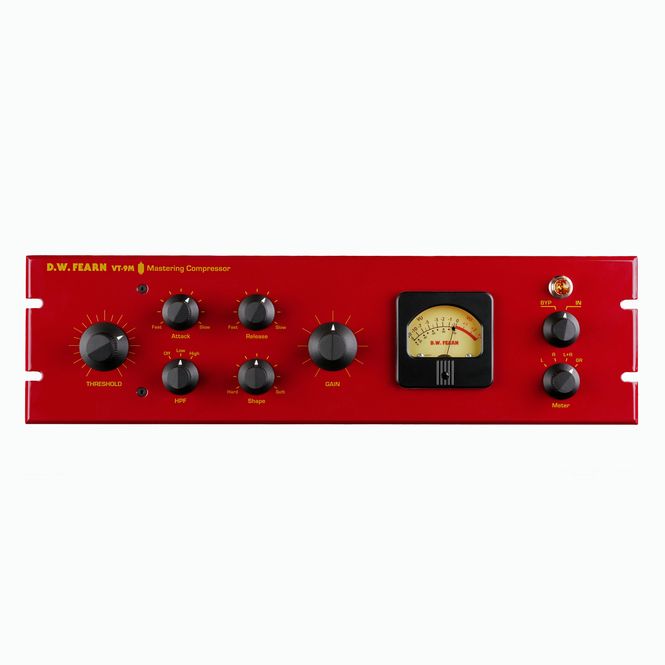
Ta kontakt for tilbud! Introducing the D.W. Fearn VT-9M :: a hand-crafted and built in the USA, the pinnacle of signal processing designed to elevate professional master mixes with legendary tube warmth, transparency, and PWM precision. :::Pure Stereo PWM Compression pairing high-end analog control, and all-tube power for ultra-low distortion ::: Architectural Highlights :: Pure Class-A Triode Signal Path Utilizes eight hand-selected 6072A vacuum tubes for ultimate harmonic richness, clarity, and extended headroom without harsh artifacts. True Stereo Operation :: Two independent channels equipped with precision precision-linked gain reduction tracking to maintain flawless stereo image stability. Advanced Pulse Width Modulator :: Modern gain-control circuitry delivering ultra-smooth, musical compression dynamics across complex master stems and studio tracking. Transformer coupled :: Built with hand selected US made input bridging transformers and custom-wound output transformers optimized for modern studio integration. Key Operational Features :: Sidechain High-Pass Filter (HPF): Features Off, Low, and High settings to eliminate heavy bass-induced "pumping" and protect low-end integrity. Adjustable Compression Curve ("Shape"): Seamlessly shifts behavior from gentle, transparent leveling (Softer) to assertive, tightly controlled limiting (Harder). True VU Metering: Conforms strictly to ASA Standard C16.5-1954, switchable to monitor Left/Right output, L+R sum, or true Gain Reduction (GR). True Bypass Circuitry: Allows instant, uncolored A/B comparisons with zero insertion loss when switched out. Hand-Crafted Excellence: Not mass-produced. True Boutique Independent and US made. Each VT-9M is meticulously engineered, wired, burned-in, and rigorously tested by hand before leaving the workshop. Backed by a Limited 7-Year Warranty (90 days on vacuum tubes). :::: Circuitry: Class-A triode vacuum tube audio path utilizing eight 6072A dual triodes with modern pulse-width modulation (PWM) control circuitry. Input Impedance: 32k ohms transformer-balanced bridging (Hand-Selected input transformer). Frequency Response: ± 0.2 dB 20 cps to 20 kc :: ± 0.5 dB 11 cps to 28 kc :: -3 dB @ 0.5 cps & 65 kc Distortion: THD + Noise $< 0.05%$ (20 cps to 20 kc). Signal-to-Noise Ratio: 78 dB minimum. Output: low-Z, transformer balanced - 115 ohms Maximum Output Level: +22 dBm into a bridging input balanced or unbalanced. Gain Reduction Range: 0 to 20 dB. Power Requirements: 115 or 230 VAC, 50/60 Hz, 85 W.
Emperical Labs ...

11.495,-

12.995,-

  With over two years of meticulous development and testing behind it, the DocDerr provides an unprecedented combination of power and musicality in a compact, easy to use format. Empirical Labs’ first compressor in the API 500 format. The DocDerr’s versatile EQ, low-noise preamp, and unique dynamics section allows for shaping the tone of any track in any situation. Whether its on the road, in the studio, or in your guitar rig, the DocDerr has got you covered! The 500 Series format allows for any sticky situation and can clean up any thin guitar sounds or over-bearing vocal chains.   Multi-Purpose Tone Module   An extremely low-noise preamp capable of working with line level or instrument level signals, is followed by four sections of EQ combining a two position high pass filter with three parametric bands, each with its own set of carefully tuned frequency presets.  An internal jumper can turn the DocDerr into an unparalleled instrument preamp with 16dB of gain, ideal for acoustic guitar, bass, synths, exotic plucked instruments, etc.   The versatile EQ is followed by a unique dynamics section which offers renowned Empirical Labs compression at an unprecedented price, and an extremely musical tape emulation circuit that softens and tames high frequencies and transient spikes.  We believe it’s the best single knob “knee” compression available in this format.   One of the pivotal features of the DocDerr is the “Mix” knob which allows the user to blend the uncompressed EQ’s signal with the compressed and saturated signal.  This parallel compression technique, used by top recording and mixing engineers for many years unlocks a whole world of sonic possibilities.     Frequency Response  3 Hz to 180 kHz on eq section (-3dB points).  Dynamic Range  120 dB from maximum output (.5% THD soft clipping) to minimum output. Noise floor with Mix on 0 is typically - 91dBu.  Distortion  between .0006% and 10% at 1 KHz, depending on mode and settings.  I/O Maximum Input before hard clipping - +22dBm, "Line In" mode. Maximum Output (Mix at 0) - +28.5dBm. Impedance 120k Ohm, Instrument In Mode, output impedance is less than 75 ohms. 20K input impedance in balanced Line in mode.  Compressor Time Constants Attack time is around 1mS. Release .2 sec, fixed internally. Stereo Linkable for stereo tracks. With the EL500 powered rack, the push of a button enables linking.
Emperical Labs EL-P ...

9.295,-

10.495,-

  Originally imagined in 2014, PUMP is a single channel, 500 series rack mount compressor loaded with the kinds of features and performance you’ve come to expect from Empirical Labs. This module has serious heritage and shares family DNA with notable ELI processors including the renowned Distressor, Arousor, and Mike-E. The PUMP is destined to be a “go-to” processor for the creative audio pro that has a toolbox built around no compromise performance, quality, and value.   Starting at the top, PUMP includes controls for Input Level with a clip (BAD) indicator. There are 8 selectable compression ratios from 2:1 to 20:1 and everything in between, each with their own unique curve. Independent digitally-stepped knobs provide precise recall of Attack and Release selections – including a soft Opto-Coupler style Release. PUMP has a switchable 110Hz High Pass Filter, comprehensive Gain Reduction metering, Attack Modification (AtMod) to slow the initial onset of the attack envelope to preserve more transient content for greater overall impact – with a Bypass selection to go dry.    One of the most unique features of PUMP is AtMod, short for Attack Modification. First seen is our Arousor plug-in, AtMod is a feature never before found in a hardware compressor. AtMod gives users the ability to slow down the initial slope of the attack envelope to add just a little bit more of the transient back into the track. Whether it’s to get a little bit more snap on the snare track or more thump on the electric bass, the AtMod will let the transients through without losing your desired amount of compression.     Frequency Response 5 Hz to 175 kHz (-3dB points). Dynamic Range 125 dB from maximum output (.5%THD soft clipping) to minimum output. Distortion Between .0035% and 15% at 1KHz, depending on mode and settings. I/O Maximum Input before hard clipping – +22dBm, “ Line In” mode. Maximum Output (Mix at 0) – +28.5dBm Impedance 120k Ohm, Instrument In Mode, output impedance is less than 75 ohms. 20K input impedance in balanced Line in mode. Compressor Time Constants Attack: 200µs to 40ms. Release: 50ms to 500ms, plus Opto setting. Stereo Linkable for stereo tracks. Detector HP Filter Switchable, fixed at 110Hz Attack Modification (AtMod) Slows the initial onset of the attack envelope allowing more transient back into the track. Saturation Soft Clipper Based on the same circuit found in the Mike-E CompSat section.
Emperical Labs EL9 Mike-E

21.995,-

23.995,-

When is a mic-pre more than a mic-pre? When it gets out of the way of the sound of your microphone and lets the compressor / hi frequency “saturation” circuits do all the heavy lifting of the tonal shaping of the sound you’re recording or mixing.   The Empirical Labs “Mike-E” is exactly that tool!! The microphone amplifier has far greater dynamic range capability than most microphones found in the vast majority of the world’s recording facilities. The result of this increased dynamic range is that the “Mike-E” has the ability to act like a “straight wire with gain”. The same clarity and definition hold true for the ultra-clean “DI” (Direct Injection) input as well… until you engage the CompSat. Though the pre-amp employs an input transformer, the noise floor of the microphone amplifier is so low, undesirable noise is difficult to bring up even with the use of extreme compression settings. The best part is that pre-amps input is digitally controlled in 5db increments for complete repeatability without the normal “flakiness” which can be associated with pots and stepped attenuators over time. Speaking of “extreme compression”; the “Distressor” like compression circuit in the “CompSat™” section of the “Mike-E” can be used to wild extremes, or as subtly as the user desires. Featuring 5 distinct compression ratios (including the ever popular “Nuke” setting), the unit features absolutely repeatable attack and release time constants while you control the quantity of the desired compression via the “Drive” control.  Two “CompSat™” sections can be linked for stereo recording / mixing with ease, and should you decide you would like a completely radical “parallel compression” effect, there is no need to waste an additional fader as the “Mike-E” has the ability to mix the “wet” and “dry” elements of the signal.   The “Mike-E”’s “CompSat™” section doesn’t end there (in fact, its just the beginning!!). In addition to the entirely resettable compression chain is the “Saturator”section and the “Emphasis” section, which is where more real magic occurs.   The “Saturator” is a multi-stage “soft clipping” circuit that imparts odd and even order harmonic distortions similar to those usually associated with triode tube circuits. As the level increases a second unique “clip circuit” employs Germanium transistors in order to more severely flatten the peaks (which creates another tonal texture unique to Empirical Labs products). The “Emphasis” element is a two-stage circuit that boosts and soft clips the high frequency content of the audio before the “CompSat™” circuit, and then cuts this boosted high frequency content in a manner consistent with the use of “noise reduction” as was often applied to analog tape recorders in days gone by. “Emphasis”, working in a similar manner to analog noise reduction has the added benefit of improving the signal to noise ratio, the net result being a “hotter” and more “emotionally compelling” sound, if that is the direction the production team would like to explore.   When you combine the “Mike-E” with a “Lil FrEQ” (called the “TRAK PAK”) the amount of tone shaping power is limited only by your imagination, as you will have the power at your fingertips to create any kind of tone / texture you feel the music requires.   Frequency Response 3 Hz to 200 kHz on (No CompSat). CompSat is 3Hz - 150Khz. Optional Transformer output is 6Hz - 80kHz.  Signal to Noise 130 dB signal to Noise at 40dB gain. Maximum output is +28dBu. Distortion Rangers between .0006% and 15% depending on mode and settings.  I/O Transformer coupled Input, Active and Transformer Outputs available. High quality audio caps used internally.  Impedance Input Impedance is above 600 Ohms at all frequencies, transformer coupled. Output impedance is less than 38 ohms. Instrument in Impedance is 332K Ohms.  Attack/Decay Ranges .9 - 70mS attack. .15 - 1 Sec.  Power Consumption  15 Watts Max.  Metal Chassis Single height 1.75" high, 10" deep, 19" wide
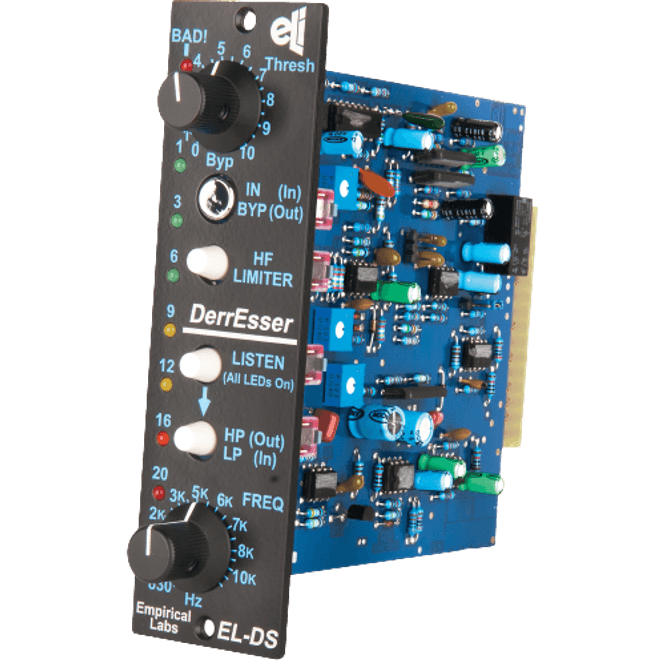
Emperical Labs ELI ELDS ...

6.195,-

6.995,-

  One of the coolest and most useful tools ever invented for the 500 Series mounting format is the Empirical Labs “DerrEsser” (a.k.a. the “EL-DS”). This seemingly small package combines a LOT of punch and control.   There are two main modes in the “DerrEsser”. The first is the “de-esser”, and the second (not necessarily in this order) is the “high frequency limiter”. While kind of similar in thought, the two modes are rather different in operation. Additionally to “de-essing” and “high frequency limiting” the “DerrEsser” can also act as a “HPF”(High Pass Filter) or “LPF” ( Low Pass Filter). When the “DerrEsser” is used as a “de-esser” the unit compares the quantity of high frequency material as it relates to the low frequency content of a sound and adjusts the high frequencies accordingly so no matter the level the relationship between the high frequency and low frequency information remains balanced.   The “corner frequency” for the action of the “de-esser” is controlled by the frequency selection knob at the bottom of the module. This corner frequency selection is made quite easy with the “LISTEN” function engaged. When “LISTEN” is engaged it becomes amazingly quick and easy to identify any problem frequencies (finger squeaks from acoustic guitars, “ssss” or “whistle” problems within a vocal, etc.), while you employ the “de-essing” function to control these problems / issues and move on with your day.   The “HF Limiter” is an entirely different, and as far as we know, an entirely unique device that solves all kinds of problems while making your day remarkably easier. The “HF Limiter” works like most limiters, but only on the high frequency content. It has a “knee”, and drops the level of the information that crosses the “threshold” so the limiter will tame the volume of the high frequency signals that has crossed the user determined threshold. However, what makes this unit unique is the shape of the limiting curve, with its smooth unobtrusive knee and its dependence on frequency as determined from the frequency selection knob on the front of the unit. Unlike “de-esser” mode, when the “HF Limiter” is engaged it is only interested in the overall volume of the high frequency information on a “stand alone” basis – the “HF Limiter”does NOT compare the high frequency information to the low frequency information as is done in “de-esser” mode. BUT WAIT – THERE’S MORE!!! If you’re a fan of “pop music” from yesteryear you have undoubtedly heard the brilliant, bright, ringing and expressive piano sounds on Elton John or Bruce Hornsby recordings. You may have marveled at the “airy” backing vocals on Def Lepard or later CARS recordings. Well now you can achieve VERY similar results in the privacy of your own home!!   One of the high profile users of the “EL-DS” discovered that if you engage the “HPF” with the “LISTEN” function, the result (which can be controlled through the frequency selection knob) is that only the “tippy-top” frequencies of the signal make it through the unit. That user found that by using a pair of “Derr-Esser”s with a pair of “EL-8X” units that they could achieve this effect with ease. This has apparently become part of that particular user’s mixing regimen where there is ALWAYS a “stereo aux” send set up with a pair of “EL-DS”s and an “EL-8XS” set that return on a fixed level “aux return”.     Frequency Response 3 Hz to 120 kHz (-3dB points).  Dynamic Range 115 dB from maximum output (.5% THD soft clipping) to minimum output. Transformerless noise floor typically - 93dBu.  Distortion Ranges between .0035% and .01% depending on mode and settings.  I/O  DC Coupled input and outputs. Input Balanced, Output single ended but with balanced impedance. Pin 2 hot.  Impedance Input Impedance is 20k Ohm. Output impedance is less than 51 ohms.  D-S Dynamics Time Constants  Attack time is less than 1mS. Release .04 sec, fixed internally  Power Consumption  8 Watts max. 4 Watts Typical.
Viser 1 til 15 (av 384 produkter)
  • vipps-orange.png
  • klarna-dark.png
  • mastercard-full.png
  • visa.png