With over two years of meticulous development and testing behind it, the DocDerr provides an unprecedented combination of power and musicality in a compact, easy to use format. Empirical Labs’ first compressor in the API 500 format. The DocDerr’s versatile EQ, low-noise preamp, and unique dynamics section allows for shaping the tone of any track in any situation. Whether its on the road, in the studio, or in your guitar rig, the DocDerr has got you covered! The 500 Series format allows for any sticky situation and can clean up any thin guitar sounds or over-bearing vocal chains.
Multi-Purpose Tone Module
An extremely low-noise preamp capable of working with line level or instrument level signals, is followed by four sections of EQ combining a two position high pass filter with three parametric bands, each with its own set of carefully tuned frequency presets. An internal jumper can turn the DocDerr into an unparalleled instrument preamp with 16dB of gain, ideal for acoustic guitar, bass, synths, exotic plucked instruments, etc.
The versatile EQ is followed by a unique dynamics section which offers renowned Empirical Labs compression at an unprecedented price, and an extremely musical tape emulation circuit that softens and tames high frequencies and transient spikes. We believe it’s the best single knob “knee” compression available in this format.
One of the pivotal features of the DocDerr is the “Mix” knob which allows the user to blend the uncompressed EQ’s signal with the compressed and saturated signal. This parallel compression technique, used by top recording and mixing engineers for many years unlocks a whole world of sonic possibilities.
Frequency Response
3 Hz to 180 kHz on eq section (-3dB points).
Dynamic Range
120 dB from maximum output (.5% THD soft clipping) to minimum output. Noise floor with Mix on 0 is typically - 91dBu.
Distortion
between .0006% and 10% at 1 KHz, depending on mode and settings.
I/O
Maximum Input before hard clipping - +22dBm, "Line In" mode. Maximum Output (Mix at 0) - +28.5dBm.
Impedance
120k Ohm, Instrument In Mode, output impedance is less than 75 ohms. 20K input impedance in balanced Line in mode.
Compressor Time Constants
Attack time is around 1mS. Release .2 sec, fixed internally. Stereo Linkable for stereo tracks. With the EL500 powered rack, the push of a button enables linking.
Originally imagined in 2014, PUMP is a single channel, 500 series rack mount compressor loaded with the kinds of features and performance you’ve come to expect from Empirical Labs. This module has serious heritage and shares family DNA with notable ELI processors including the renowned Distressor, Arousor, and Mike-E. The PUMP is destined to be a “go-to” processor for the creative audio pro that has a toolbox built around no compromise performance, quality, and value.
Starting at the top, PUMP includes controls for Input Level with a clip (BAD) indicator. There are 8 selectable compression ratios from 2:1 to 20:1 and everything in between, each with their own unique curve. Independent digitally-stepped knobs provide precise recall of Attack and Release selections – including a soft Opto-Coupler style Release. PUMP has a switchable 110Hz High Pass Filter, comprehensive Gain Reduction metering, Attack Modification (AtMod) to slow the initial onset of the attack envelope to preserve more transient content for greater overall impact – with a Bypass selection to go dry.
One of the most unique features of PUMP is AtMod, short for Attack Modification. First seen is our Arousor plug-in, AtMod is a feature never before found in a hardware compressor.
AtMod gives users the ability to slow down the initial slope of the attack envelope to add just a little bit more of the transient back into the track. Whether it’s to get a little bit more snap on the snare track or more thump on the electric bass, the AtMod will let the transients through without losing your desired amount of compression.
Frequency Response
5 Hz to 175 kHz (-3dB points).
Dynamic Range
125 dB from maximum output (.5%THD soft clipping) to minimum output.
Distortion
Between .0035% and 15% at 1KHz, depending on mode and settings.
I/O
Maximum Input before hard clipping – +22dBm, “ Line In” mode. Maximum Output (Mix at 0) – +28.5dBm
Impedance
120k Ohm, Instrument In Mode, output impedance is less than 75 ohms. 20K input impedance in balanced Line in mode.
Compressor Time Constants
Attack: 200µs to 40ms. Release: 50ms to 500ms, plus Opto setting. Stereo Linkable for stereo tracks.
Detector HP Filter
Switchable, fixed at 110Hz
Attack Modification (AtMod)
Slows the initial onset of the attack envelope allowing more transient back into the track.
Saturation Soft Clipper
Based on the same circuit found in the Mike-E CompSat section.
When is a mic-pre more than a mic-pre? When it gets out of the way of the sound of your microphone and lets the compressor / hi frequency “saturation” circuits do all the heavy lifting of the tonal shaping of the sound you’re recording or mixing.
The Empirical Labs “Mike-E” is exactly that tool!! The microphone amplifier has far greater dynamic range capability than most microphones found in the vast majority of the world’s recording facilities. The result of this increased dynamic range is that the “Mike-E” has the ability to act like a “straight wire with gain”. The same clarity and definition hold true for the ultra-clean “DI” (Direct Injection) input as well… until you engage the CompSat.
Though the pre-amp employs an input transformer, the noise floor of the microphone amplifier is so low, undesirable noise is difficult to bring up even with the use of extreme compression settings. The best part is that pre-amps input is digitally controlled in 5db increments for complete repeatability without the normal “flakiness” which can be associated with pots and stepped attenuators over time.
Speaking of “extreme compression”; the “Distressor” like compression circuit in the “CompSat™” section of the “Mike-E” can be used to wild extremes, or as subtly as the user desires. Featuring 5 distinct compression ratios (including the ever popular “Nuke” setting), the unit features absolutely repeatable attack and release time constants while you control the quantity of the desired compression via the “Drive” control. Two “CompSat™” sections can be linked for stereo recording / mixing with ease, and should you decide you would like a completely radical “parallel compression” effect, there is no need to waste an additional fader as the “Mike-E” has the ability to mix the “wet” and “dry” elements of the signal.
The “Mike-E”’s “CompSat™” section doesn’t end there (in fact, its just the beginning!!). In addition to the entirely resettable compression chain is the “Saturator”section and the “Emphasis” section, which is where more real magic occurs.
The “Saturator” is a multi-stage “soft clipping” circuit that imparts odd and even order harmonic distortions similar to those usually associated with triode tube circuits. As the level increases a second unique “clip circuit” employs Germanium transistors in order to more severely flatten the peaks (which creates another tonal texture unique to Empirical Labs products).
The “Emphasis” element is a two-stage circuit that boosts and soft clips the high frequency content of the audio before the “CompSat™” circuit, and then cuts this boosted high frequency content in a manner consistent with the use of “noise reduction” as was often applied to analog tape recorders in days gone by. “Emphasis”, working in a similar manner to analog noise reduction has the added benefit of improving the signal to noise ratio, the net result being a “hotter” and more “emotionally compelling” sound, if that is the direction the production team would like to explore.
When you combine the “Mike-E” with a “Lil FrEQ” (called the “TRAK PAK”) the amount of tone shaping power is limited only by your imagination, as you will have the power at your fingertips to create any kind of tone / texture you feel the music requires.
Frequency Response
3 Hz to 200 kHz on (No CompSat). CompSat is 3Hz - 150Khz. Optional Transformer output is 6Hz - 80kHz.
Signal to Noise
130 dB signal to Noise at 40dB gain. Maximum output is +28dBu.
Distortion
Rangers between .0006% and 15% depending on mode and settings.
I/O
Transformer coupled Input, Active and Transformer Outputs available. High quality audio caps used internally.
Impedance
Input Impedance is above 600 Ohms at all frequencies, transformer coupled. Output impedance is less than 38 ohms. Instrument in Impedance is 332K Ohms.
Attack/Decay Ranges
.9 - 70mS attack. .15 - 1 Sec.
Power Consumption
15 Watts Max.
Metal Chassis
Single height 1.75" high, 10" deep, 19" wide
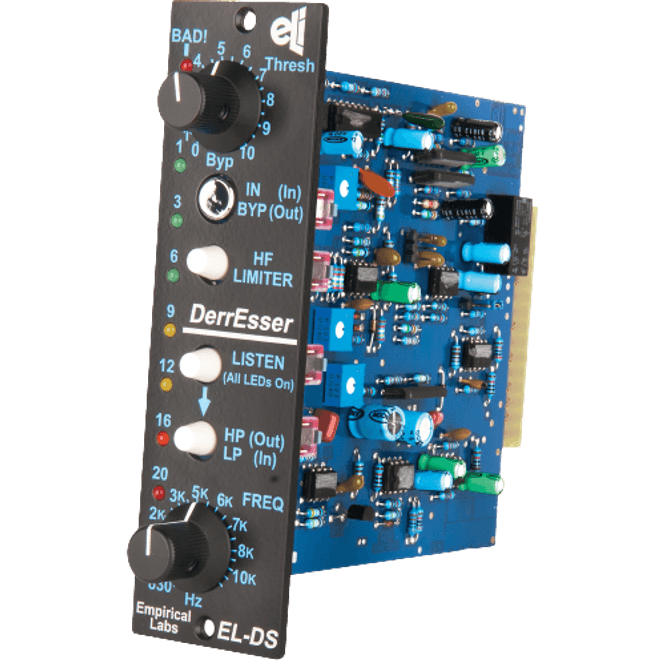
One of the coolest and most useful tools ever invented for the 500 Series mounting format is the Empirical Labs “DerrEsser” (a.k.a. the “EL-DS”). This seemingly small package combines a LOT of punch and control.
There are two main modes in the “DerrEsser”. The first is the “de-esser”, and the second (not necessarily in this order) is the “high frequency limiter”. While kind of similar in thought, the two modes are rather different in operation. Additionally to “de-essing” and “high frequency limiting” the “DerrEsser” can also act as a “HPF”(High Pass Filter) or “LPF” ( Low Pass Filter).
When the “DerrEsser” is used as a “de-esser” the unit compares the quantity of high frequency material as it relates to the low frequency content of a sound and adjusts the high frequencies accordingly so no matter the level the relationship between the high frequency and low frequency information remains balanced.
The “corner frequency” for the action of the “de-esser” is controlled by the frequency selection knob at the bottom of the module. This corner frequency selection is made quite easy with the “LISTEN” function engaged. When “LISTEN” is engaged it becomes amazingly quick and easy to identify any problem frequencies (finger squeaks from acoustic guitars, “ssss” or “whistle” problems within a vocal, etc.), while you employ the “de-essing” function to control these problems / issues and move on with your day.
The “HF Limiter” is an entirely different, and as far as we know, an entirely unique device that solves all kinds of problems while making your day remarkably easier. The “HF Limiter” works like most limiters, but only on the high frequency content. It has a “knee”, and drops the level of the information that crosses the “threshold” so the limiter will tame the volume of the high frequency signals that has crossed the user determined threshold. However, what makes this unit unique is the shape of the limiting curve, with its smooth unobtrusive knee and its dependence on frequency as determined from the frequency selection knob on the front of the unit. Unlike “de-esser” mode, when the “HF Limiter” is engaged it is only interested in the overall volume of the high frequency information on a “stand alone” basis – the “HF Limiter”does NOT compare the high frequency information to the low frequency information as is done in “de-esser” mode.
BUT WAIT – THERE’S MORE!!!
If you’re a fan of “pop music” from yesteryear you have undoubtedly heard the brilliant, bright, ringing and expressive piano sounds on Elton John or Bruce Hornsby recordings. You may have marveled at the “airy” backing vocals on Def Lepard or later CARS recordings. Well now you can achieve VERY similar results in the privacy of your own home!!
One of the high profile users of the “EL-DS” discovered that if you engage the “HPF” with the “LISTEN” function, the result (which can be controlled through the frequency selection knob) is that only the “tippy-top” frequencies of the signal make it through the unit. That user found that by using a pair of “Derr-Esser”s with a pair of “EL-8X” units that they could achieve this effect with ease. This has apparently become part of that particular user’s mixing regimen where there is ALWAYS a “stereo aux” send set up with a pair of “EL-DS”s and an “EL-8XS” set that return on a fixed level “aux return”.
Frequency Response
3 Hz to 120 kHz (-3dB points).
Dynamic Range
115 dB from maximum output (.5% THD soft clipping) to minimum output. Transformerless noise floor typically - 93dBu.
Distortion
Ranges between .0035% and .01% depending on mode and settings.
I/O
DC Coupled input and outputs. Input Balanced, Output single ended but with balanced impedance. Pin 2 hot.
Impedance
Input Impedance is 20k Ohm. Output impedance is less than 51 ohms.
D-S Dynamics Time Constants
Attack time is less than 1mS. Release .04 sec, fixed internally
Power Consumption
8 Watts max. 4 Watts Typical.
Ta kontakt for tilbud!
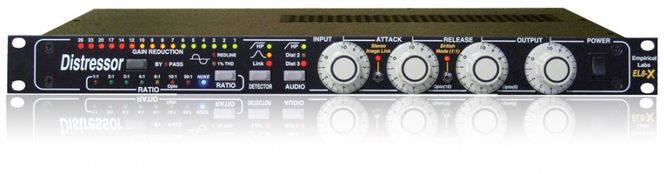
DISTRESSOR Product Description
The Distressor is an automatic gain (or volume) control device (AGC in engineering terms) designed for pro audio (music) applications. Basically, it electronically controls the volume of just about any source in a very pleasing, and "musical" manner - adding fullness, intelligibility, and especially in the Distressor's case - excitement. This type of device is often called a "limiter" or "compressor" by audio industry people. Its most probable uses will be in recording studios, live sound situations, movie sound production, and radio broadcast production.
Unlike most analog compressor/limiters the Distressor is a digitally controlled audio device and actually incorporates several products into one by utilizing digital controls to switch totally different circuits in and out. Years of beta testing and redesign went into the Distressor as will be the case with all Empirical Labs products.
Besides offering a wide range of control and unique features, the Distressor offers a warm, vintage sound by using a custom designed gain control circuit. This "warmth" or vintage sound has become an important issue in the last 15 years, as the super clear and linear digital technology does very little (or nothing) to soften "harsh" sounds nor emphasize the bass frequencies in music sources. Older analog tape, vinyl records and tube equipment on the other hand, could not be prevented from coloring the sound, often to the frustration of recording engineers. However, many people have now realized that this coloring can be extremely pleasant and "musical".The current digital technology is often referred to as "cold" and "brittle" among other terms, although we prefer the term "unforgiving" to describe the negative side of the "linearity". The Distressor offers several modes that color the signal, even without compression (or gain control). These extended modes were designed to allow emulation of some very old and some very expensive vintage gain control units (compressors & limiters) and deliver a classic "knee" sound all its own.
Specifications:
* Freq. response is 2 Hz to 160 kHz in clean audio mode (+0, -3 dB). Response is shaped in distortion modes (Dist 2, Dist 3).
* Dynamic range 110 dB from max. output to min. output in 1:1 mode. Greater than 100 dB signal to noise in distort 3 mode.
* Distortion ranges between .02% and 20% depending on distortion mode and release times set on front panel.
* DC coupled output - High quality input caps.
* Input impedance is 20K Ohms, Output impedance is < 75 ohms
* Time constants - Attack range 50uS - 50mS. Release range .05 sec to 3.5 seconds, normal modes and up to 20 seconds in 10:1 opto mode. Time constants are dependant on ratio.
* Metal Chassis - single height 1.75" high, 10" deep, 19" wide.
* Shipping info - 12.1 lbs mono, 24.2 lbs Stereo pair. Mono box dimensions 22.5" x 18.5" x 3 1/4". Stereo Pair box dimensions 22.5" x 18.5" x 6 1/4
Ta kontakt for tilbud!
How many times have we heard ourselves, other engineers and even musicians say “I like the sound of tape, it’s sooooo musical”? We hear it in recording schools, we read about it on forums, we think about it in our spare time; but seriously, who among us who isn’t on the wrong side of 40 has really experienced tape? …or enjoys the inconvenience of tape machine alignment?
Enter the FATSO “EL7” (Full Analog Tape Simulator & Optimizer), which can help eliminate the pining for the forgotten days of great big clunky analog tape machines (and ALL of their associated headaches!!). No longer did the production team have to decide between Scotch 250 or Ampex 456; no longer does the mix engineer have to decide between BASF 911 or Zonal 999 for final mixdown. No longer would engineers argue the merits of an Ampex ATR-102 vs a Studer A-80-RC because the FATSO can give you the positive attributes of ALL of these things, in an adjustable and repeatable manner, without having to stress over sticking with an initial decision!!
The FATSO can give you the same “harmonic generation” and “soft clipping” you hear when using tape or “classic” tube-based devices. The FATSO can give you the “high-frequency saturation” you could find by driving tape a bit harder than the design engineers had hoped you would (especially true of Ampex 456!!). The FATSO can give you the sweet high end and intimate harmonic overtones of transformers; the analog anomalies that are associated with the “classic” equipment of the 60’s, 70’s and 80’s, all without constant calibration or the “stop and wait” rewind time “vibe breaker”.
The FATSO has 4 meticulously tweaked compression modes. There is the “BUSS” setting that gives gentle transient saturation that is synonymous with tape, and settings reminiscent of the SSL® “Quad Compressor”. “SPANK” gives you the subtle knee followed by the hard limiting many of us grew to love on SSL® “E Series” consoles. The new “ELEVEN” setting gives you the wonderfully unique texture of a vintage 1176 LN run at 20:1 set to its slowest attack (which is still quite fast!) and rather quick release that nets the full force and unique impact of the transients of a sound (think snare drum) with radically limited dynamic range throughout the rest of the signal. Then there is the TRACK-ing compressor which is closest to the classic Empirical Labs EL8 “Distressor” sound, and even easier to use.
Additionally, there are seven (7) different “warmth” settings that help emulate different tape formulations and machine anomalies, along with the greatest button ever installed on any unit ever built: the “TRANNY” button which gives you the final “over the top” harmonic content, compelling low-frequency focus, while adding breath and urgency to any sound it meets. With the choice of XLR or ¼” inputs along with the ability to link several units together for 5.1 operation, the FATSO can cure any of the lameness found in the most common analog to digital converter sets, while giving your music the width and breadth that makes folks wax nostalgic for $300 reels of tape and 500+ pound tape machines.
You have already heard the FATSO thousands of times on major and minor recordings over the years! If you’re serious about your recording work. you owe it to yourself to arrange a demo from your favorite reseller in order to discover the magic you can uncover with this unique instrument (that doubles as a piece of your recording kit).
Frequency Response
2 Hz to 60 kHz in clean audio mode (+0, -3 dB)
Dynamic Range
110 dB from maximum output (20 %THD soft clipping) to minimum output. Greater than 100 dB signal to noise.
Distortion
Ranges between .06% and 20% depending on mode and settings.
I/O
DC Coupled input and outputs.
Compressor Time Constants
Attack range 1ms – 60ms. Release range .05sec – 3.5 seconds. Attack and Releases are fixed by the compression type selected.
Power Consumption
15 Watts Max.
Metal Chassis
Single height 1.75″ high, 10″ deep, 19″ wide.
Ta kontakt for tilbud!
DISTRESSOR Product Description
The Distressor is an automatic gain (or volume) control device (AGC in engineering terms) designed for pro audio (music) applications. Basically, it electronically controls the volume of just about any source in a very pleasing, and "musical" manner - adding fullness, intelligibility, and especially in the Distressor's case - excitement. This type of device is often called a "limiter" or "compressor" by audio industry people. Its most probable uses will be in recording studios, live sound situations, movie sound production, and radio broadcast production.
Unlike most analog compressor/limiters the Distressor is a digitally controlled audio device and actually incorporates several products into one by utilizing digital controls to switch totally different circuits in and out. Years of beta testing and redesign went into the Distressor as will be the case with all Empirical Labs products.
Besides offering a wide range of control and unique features, the Distressor offers a warm, vintage sound by using a custom designed gain control circuit. This "warmth" or vintage sound has become an important issue in the last 15 years, as the super clear and linear digital technology does very little (or nothing) to soften "harsh" sounds nor emphasize the bass frequencies in music sources. Older analog tape, vinyl records and tube equipment on the other hand, could not be prevented from coloring the sound, often to the frustration of recording engineers. However, many people have now realized that this coloring can be extremely pleasant and "musical".The current digital technology is often referred to as "cold" and "brittle" among other terms, although we prefer the term "unforgiving" to describe the negative side of the "linearity". The Distressor offers several modes that color the signal, even without compression (or gain control). These extended modes were designed to allow emulation of some very old and some very expensive vintage gain control units (compressors & limiters) and deliver a classic "knee" sound all its own.
Specifications:
* Freq. response is 2 Hz to 160 kHz in clean audio mode (+0, -3 dB). Response is shaped in distortion modes (Dist 2, Dist 3).
* Dynamic range 110 dB from max. output to min. output in 1:1 mode. Greater than 100 dB signal to noise in distort 3 mode.
* Distortion ranges between .02% and 20% depending on distortion mode and release times set on front panel.
* DC coupled output - High quality input caps.
* Input impedance is 20K Ohms, Output impedance is < 75 ohms
* Time constants - Attack range 50uS - 50mS. Release range .05 sec to 3.5 seconds, normal modes and up to 20 seconds in 10:1 opto mode. Time constants are dependant on ratio.
* Metal Chassis - single height 1.75" high, 10" deep, 19" wide.
* Shipping info - 12.1 lbs mono, 24.2 lbs Stereo pair. Mono box dimensions 22.5" x 18.5" x 3 1/4". Stereo Pair box dimensions 22.5" x 18.5" x 6 1/4