Hopp til innhold

Norsk nettbutikk | Rask levering | Frakt i hele Norge

Analog Signalbehandling

Utforsk analog signalbehandling som gir varme, karakter og kontroll. Perfekt for miksing, mastering og kreativ lydforming.

SSL 18 26-in / 28-out, ...

9.895,-

11.995,-

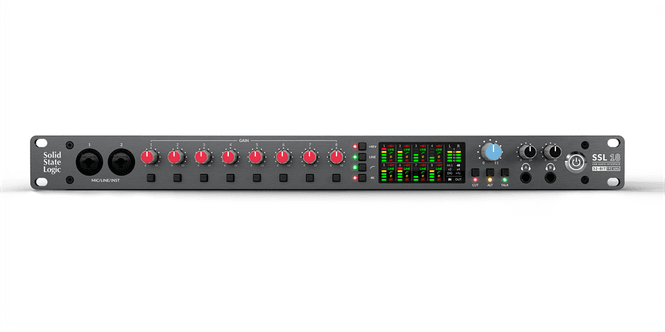
    A New Era Has Begun   Introducing SSL 18 - a new era in rackmount production technology from Solid State Logic. Developed from our unmatched expertise in analogue and digital design, SSL 18 offers exceptional audio performance with a studio session-ready feature set, delivered with the signature SSL sound and premium quality that professionals trust. Whether you are recording, producing or mixing, SSL 18 enhances production workflows while elevating the performance of your creative space, it’s the ultimate centrepiece for your studio. Welcome to a new era in rack mount interface performance.        10 x Line-outputs SSL 18 comes equipped with ten balanced line-level outputs located on the rear of the unit. To ensure optimal signal integrity and maximise headroom, line outputs 1&2 and 3&4 can be configured between +9 and +24 dBu, providing seamless compatibility with a wide range of studio monitors and vintage equipment operating at lower levels. Outputs 3 to 10 operate at +24 dBu, perfect for integrating professional outboard equipment. For producers, all outputs are DC-coupled and capable of sending control voltage to synthesizers and modular rigs. Dual High-Performance Headphone Outputs Custom headphone mixes with two independent headphone outputs, configurable for different types with 'Standard', 'High Sensitivity', and 'High Impedance' settings. SSL 18's headphone outputs can also be repurposed as line-level outputs for added flexibility.    120dB Dynamic Range Dual Independent Outputs Configurable Headphone Modes   Monitor Controller + Talkback w/Listen Mic Compressor SSL 18 features a full monitor controller section with built-in talkback input. Line outputs 1&2 and 3&4 offer alternative speaker switching with Alt and Cut accessible via the monitor controls located on the front panel. Alternatively, customise the monitor controls via SSL 360 and tailor them to your workflow. SSL 18 also features a dedicated talkback input channel that can operate in MIC or LINE mode. LINE mode is great for re-processing audio through the classic Listen Mic Compressor - crush drums, parallel vocals, and more. Configurable monitoring section / Alt monitor switching / Talkback input + Legendary Listen Mic Compressor     prevnext Tech Specs   System requirements and Specs: Mac OS 13 or later | Class-Compliant, Plug-and-play Windows 10, Windows 11 | Install included ASIO/WDM driver   Connectivity USB 2.0 Type C Connector (Box includes Type C to C and Type C to A)   Mic Preamps  8 x XLR-¼" combo (Mic/Line)  Mic Amp EIN (A-weighted) : -130.5 dBu Mic Amp Gain: 67 dB   Instrument/Line 2 x ¼" (Hi-Z)  Max Instrument Input Level: +15 dBu Max Line Input Level: +24 dBu Dynamic Range (A-weighted) 120 dB typical      
Wolf Audio MeMore

15.750,-

18.750,-

  MeMore is a Personal Monitor Mixer designed to provide an artist with complete, intuitive control of individual mixes. The absolute requirement: get a mix, always stay focused and in the groove. MeMore has no menus and no screens. Everything is on the front panel to be twisted or pushed - simple, intuitive and instant. 12 input channels: 8 Mono inputs and 2 Stereo for comprehensive channel count. 2 headphone amps with separate volume controls and they are LOUD! Built-in “HearMe” mic is used for the talkback channel and unique room mic foldback into the mix.     All I/O is accessible via 4 DSUB connections on the rear panel (and mirrored on the bottom panel for mic stand mount applications). Each channel includes a pan pot, level control and the useful T-Q EQ found on Wolff consoles — a “tilt” style one knob equalizer. Channels 9/10 and 11/12 also have dedicated inputs to receive dedicated input signals. Each input channel has a PFL level LED (full intensity at +4dBu). The Main Headphone Master Output level controls also have a post fade level LED. Each output is paired and driven by internal amplifiers with isolated power to minimize crosstalk. The industry standard 500 series power supply delivers mega punch.     Cascade as many MeMore units as necessary to create personalized mixes for everyone. The HearMe mic mixes into the headphone feed through a unique 2:1 compressor that provides room perspective, perfect for background singers or drummers. The same mic also facilitates private communication with the control room using the Talk button on the front panel (or using the 1/4 output jack that supports a “sustain” style foot switch). The talkback signal is also available via a dedicated jack on each unit. Connecting MeMores together uses standard DB25 cables (or analog over CAT6 with available “RATCAT” adaptor). The MeMore keeps it simple, effective and exceptionally clean with reliable analog mixing.
Wolf Audio ProPatch 128R(128 ...

105.875,-

128.375,-

    At the heart of every ProPatch is Wolff Audio’s proprietary relay based, software controlled switching architecture. A patchbay’s role is to route signals without affecting them—a purely passive connection. ProPatch contains no buffers, amplifiers, or active electronics in the signal path. None. Active circuitry, by definition, alters how connected gear interacts: introducing noise, affecting impedance, shifting frequency response, and potentially disrupting 48V phantom power. ProPatch’s relay based passive signal path delivers direct, balanced routing with no coloration, no interference, and no compromise. ProPatch signal chains are configured and managed using an app that supports Windows, Mac or iPad OS. The app provides easy to use creation of complex device chains, including mults, mono to stereo, inserts, processors, AB groups and many more intuitive and useful shortcuts. All of these can be saved, recalled and associated with sessions.     Using relay switching has many advantages. It is ultra-reliable, based on telecom-scale technology rated for millions of cycles. It requires little power to operate and generates no heat, eliminating the need for a fan. Because the signal path is “just a wire,” it can pass full bandwidth audio signal, mic level, phantom power, control voltage, digital audio and MIDI. It is agnostic to the signals being routed. The relays are latching, so if a ProPatch loses power, the current routing remains in effect. The soft click of a physical relay cues that routing changes have happened. Connect the web enabled app to ProPatch via USB-C or Ethernet. Use the app to setup or adjust current routings or to configure and store new presets. The last configuration will load immediately on power-up. Rear panel DB25 connectors provide 48 channels of I/O, while front panel I/O includes 16 TT I/O pairs, 4 XLR/TRS combi jacks and 4 TRS jacks. Use these to integrate ProPatch into an existing TT patchbay system, quickly connect temporary gear, or scale up and create a larger system by interconnecting multiple ProPatch units. Eliminate the usual workflow pause experienced when configuring manual patch bay systems and keep projects in the groove and flowing with ProPatch.     128 PATCH POINTS, 64 X 64 I/O, ANY-TO-ANY ROUTING STRAIGHT WIRE PERFORMANCE, RELAY BASED, ZERO ELECTRONICS IN THE SIGNAL PATH FREQUENCY RESPONSE FROM DC TO LIMIT OF THE TEST EQUIPMENT 0% DISTORTION AND NOISE, DC TO LIMIT OF THE TEST EQUIPMENT 100% BALANCED INTERNAL SIGNAL PATH CONFIGURE ROUTING PRESETS FOR INSTANT RECALL LAST USED PROPATCH CONFIGURATION IS NON-VOLATILE AND AUTO-LOADS ON POWER UP USE THE “WOLFF HOUND” UTILITY APP TO CONNECT TO A PROPATCH ON THE NETWORK CREATE SIGNAL CHAINS WITH “AB” BLOCKS TO AUDITION ALTERNATE DEVICES AND PATHS ACCEPTS MULTIPLE SIGNAL TYPES INCLUDING MIC, LINE, CONTROL VOLTAGE, MIDI AND TIMECODE PASSES 48V PHANTOM POWER. SWITCHING IS INSTANT, ALLEVIATING PHANTOM SHORT ISSUES HIGHEST CHANNEL DENSITY PER RACK UNIT OF ANY PATCHBAY (TRADITIONAL OR AUTOMATED) SINGLE RACK UNIT CHASSIS, NO HEAT, NO FANS
Z&H Designs 1178 Stereo ...

27.995,-

29.995,-

We created a mastering version out of our beloved 1178 Stereo Peak Limiter, thanks to an idea from the community. This special build shares the same sonic expression as the standard Z&H 1178, plus the same signal processing chain as the original UREI.   The "Mastering 1178" comes with an onboard M/S-L/R switch, which is paired with separate attack & release controls. It also has a mix knob and a sidechain HPF - the must haves for today's production.   Catering to a mastering workflow, it offers 21 steps on all 8 knobs of Input, Output, Attack, and Release. We also hand-matched the 2 channels to 0.1dB accuracy.   Exact & rare electric components as the original UREI 1178. Stepped compressor controls for mastering workflow. Handles high dynamics with high accuracy. Onboard M/S functionality. Capable of clean & colourisation. Can work as 2 legit FET compressors. Sidechain high pass filter. Find the sweet spot with mix knob. Linear power supply.
API Audio 3124V 4-Channel ...

NB:Ta kontakt for vår beste pris!   Features Classic API Circuit Design Uses API 2520 Op Amps Variable Output Level Control 3:1 Output Transformer Tap Selection Four female XLR mic inputs  Four front panel 1/4" Hi Z instrument inputs Front panel polarity switches Front panel -20dB pad switches Front panel mic/instrument switches Front panel 48V power switches Like the API 3124+, the 3124V is a high quality, compact, 4-channel mic preamp. It is equipped with the AP2516 input transformer and the proprietary output transformer found in all API mic pres and throughout the API product line. Additionally, the 3124V offers Variable Output Level Control and switchable 3:1 output transformer selection. The unit has an internal 48-volt phantom power supply, which is switchable for each channel, as well as -20dB pad switches that affect both the mic and Hi-Z instrument inputs, both located on the front panel. The 3124V also features up to 65dB of gain. Additionally, the Hi-Z front panel inputs feed directly to the op amps, which allow a low level input such as a guitar or bass to be amplified without a matching transformer or direct box. These Hi-Z inputs can take levels as high as +20dBu, making them perfect for keyboards and other high level devices. The mic preamp outputs are on rear panel male XLR connectors.
Black Lion Audio MicroCLock ...

14.320,-

15.320,-

The Micro Clock MKIII XB is the most accurate word clock we’ve developed to date. With only 0.6pS RMS of jitter at the BNC outputs, it has less than one third of the jitter of the standard Micro Clock MKIII! It boasts incredibly accurate crystal oscillators and superior quality galvanic isolation, both of which contribute to the extraordinarily low jitter measurement.   We spent the better part of a year field-testing the Micro Clock MKIII XB prior to its release, and got a lot of positive feedback on the impact it made in a wide variety of setups. Its small form factor and its ability to drive up to 1,000 feet of coaxial cable make it not only the perfect solution for improving the conversion quality of an audio interface, but also for re-clocking digital mixing consoles at live shows or houses of worship, and as the master word clock in large post-production or broadcast facilities. It can easily sync all of your digital gear together, even if it’s located in different rooms, or different buildings!
Buzz Audio REQ-2.2 MEA ...

98.250,-

106.250,-

Ta kontakt for tilbud! MEA=Resonance equalizer, mastering version, Elma stepped boost/cut, active low band section (ALB). A high end stereo inductor based recording and mastering parametric equalizer, that operates and sounds like no other!   design features the resonance factor The REQ-2.2 mastering equalizer utilises parallel resonant circuits in a clever configuration whereby the bandwidth (Q) of the circuit can be adjusted like an active filter, but without any complex relay switching. The inductor/capacitor resonant "tank" eq circuit runs at a low internal signal level which avoids any inductor saturation effects. The overall result is the sound of real choke based filters with a big open sound, but without the limitation of only a few - or no bandwidth selections as found on traditional choke eq's. audio path quality As you would expect, the REQ uses our BE40 True Class A circuits developed for the MA-2.2 microphone amplifierfor superlative audio performance. It also utlilizes our BE44 discrete line driver at the output that acts like a transformer and can respond to balanced or unbalanced loads.  But sometimes you might need a bit more color, so we have included a saturation section that introduces measured amounts of low frequency harmonic distortion via a steel audio transformer driven by a single ended tansistor amplifier. The High Pass Filter is placed in the beginning of the eq chain and the Low Band eq section is placed last in the chain. This layout produces the best overall equalizer coherency. operational beauty The large knobs and positive feel of the switching make the REQ a pleasure to operate and everything is visually clear when mounted into a console. In total there are 72 frequency choices per channel with overlapping selections across the four bands so you can always find the centre frequency you are looking for. A looping line XLR input and two parallel XLR outputs provide flexible connection options in the mastering control room. Finally, low glare rustic silver finish and retro Elma knobs give the REQ an impressive look in your rack! controls and functions Each eq band has a 12 position switch to select the FREQUENCY and another that selects the BANDWIDTH or shape of the bell shape curve (Q) which is adjustable from 1/3 octave to 2 octaves wide. On the High and Low bands, the BANDWIDTH control reverts to shelf SLOPE control when SHELF mode is selected via the push button switch (but not with the Active Low Band option fitted). The Low and High Mid bands frequency range is changed to alternative selections when the FREQ x2.5 mode is selected. Each band also has an IN/OUT switch removing the band completely from the signal path. The BOOST/CUT control is a 23 postion Elma switch with a range of +/-8dB, with 0.5dB steps up to 3dB then 1dB steps to 8dB. Custom ranges and steps can be supplied to special order. On the right side of the front panel are the HIGH PASS FILTER and SATURATION controls with their own IN/OUT switches. The overall SYSTEM IN/OUT controls and the power switch complete the picture. The channel A and channel B push button switches (SYSTEM, HPF and SATURATION) can be grouped by holding down any switch for 5 seconds. This means for stereo work you only need to push either the channel A or B switch to change both channels simultaneously. (This feature only applies to units with serial number Q1110 and up).  options The REQ is available with a silver-grey or black face plate. Only the mastering version is manufactured with the recording version now discontinued. There is an option for the Low Band section of the REQ. This option replaces the Choke based eq filter with an Active filter which provides a "tighter" bass sound. This option (the ALB) has come about from requests from some users who work with modern music styles in mastering. The only operational difference between the Active and Choke filters is that in Shelf mode, the Bandwidth control does not work as a slope control and is disabled. You can also order the REQ with Lundahl output transformers. When fitted, the direct balanced line out is available on the LINE OUT 1 XLR connectors and the transformer coupled output on the LINE OUT 2 XLR connectors. There are two Lundahl options, the LL1517 audio C-core or the LL1684 amorphous core (expensive!).   Mastering version with choke filter low band - REQ-2.2ME | US$7150 | €6360 | £5540 | Mastering version with active filter low band - REQ-2.2MEA | US$7150 | €6360 | £5540 | Lundahl LL1517 transformer option (both channels) | US$210 | €190 | £165 | Lundahl LL1684 transformer option (both channels) | US$350 | €320 | £285 |   We have in the past supplied custom front panel finishes, custom mastering boost/cut ranges, please feel free to contact us to discuss your desires! If you are looking for the REQ upgrade info it is here.    frequency chart LOW FREQ LOW MID FREQ  x1 LOW MID FREQ  x2.5 HIGH MID FREQ  x1 HIGH MID FREQ  x2.5 HIGH FREQ HPF  30Hz 85Hz 215Hz 560Hz 1410Hz 1870Hz 20Hz 45Hz 110Hz 275Hz 710Hz 1780Hz 2360Hz 26Hz 60Hz 135Hz 340Hz 910Hz 2280Hz 3000Hz 34Hz 75Hz 170Hz 450Hz 1150Hz 2750Hz 3700Hz 46Hz 95Hz 210Hz 540Hz 1450Hz 3550Hz 4800Hz 58Hz 120Hz 260Hz 660Hz 1700Hz 4230Hz 5900Hz 70Hz 150Hz 320Hz 820Hz 2100Hz 5200Hz 7250Hz   185Hz 400Hz 1000Hz 2650Hz 6500Hz 8800Hz   230Hz 500Hz 1300Hz 3450Hz 8100Hz 10.8kHz   290Hz 610Hz 1525Hz 4000Hz 10kHz 13.5kHz   350Hz 750Hz 1880Hz 4900Hz 12kHz 16.5kHz   440Hz 930Hz 2330Hz 6250Hz 15.5kHz 20.5kHz    
Chameleon Labs 7721 STEREO ...

18.625,-

20.625,-

7721 Stereo VCA Compressor   The Chameleon Labs 7721 Stereo VCA compressor is a powerful analog processor designed to make your tracks sound more compact and powerful.   DESCRIPTION When designing the 7721, Chameleon’s engineers started with a clean sheet of paper and deeply evaluated the details associated with developing a bus compressor for the modern studio. Basing detection and voltage control on a voltage control amplifier (VCA) topology and designing a circuit that provides low noise and transparency the team created an acoustic “glue" that is capable of consistently delivering punch and loudness to the signal. The 7721 provides a classic set of adjustable settings as well as controls only available on esoteric compressors, including: - Soft Knee / Hard Knee – Allows you to change between a softer arriving compression effect and a faster arriving, limiting type effect. - Peak / RMS – This control allows you to choose between the Peak and RMS detection schemes that are quite different. Peak detection engages the compressor by monitoring peak or instantaneous voltage signals. RMS engages by looking at the average energy in the signal and comparing it to the threshold setting. Very different modes of operation that provide great solutions for specific problems. - High Pass Filter – Allows you to filter out low frequencies and avoid pumping effects. This is particularly helpful when using the sidechain to more precisely control which frequencies are being compressed. - Classic Controls – Threshold / Attack / Release / Ratio – Low ratios provide a nice starting place for master transparency, 4:1 provides more color and higher ratios for a tougher sound full of character. We like to use Attack and Release controls to respond to tempo and feel of a track. - Blend – This control allows you to blend, or mix, the original uncompressed signal with the compressed signal providing another tool you can use to obtain your desired objective. - VU Meter - Monitor Input, Outputs and Gain Reduction levels. 7721 FEATURES Stereo compressor with VCA-based signal detection Super low noise, IC based input section Side chain input allows a separate source to be used as the compression trigger IC based, ultra-low noise output stage VU meter for Input / Output Level and Gain Reduction monitoring Super low noise internal power supply Selectable high pass filter Threshold, Attack, Release and Ratio controls Selectable detection type Peak or RMS Selectable compression types: Soft or Hard Knee Blend control allows you to mix the compressed audio signal with the original signal   SPECIFICATIONS User Controlled Functions On Switch: Turn Pre Amp On - VU Meter Light Compression: Insert compression circuit or bypass Side Chain: Use Side Chain input for triggering Compression: Soft or Hard Knee compression type Detection: Peak or RMS High Pass Filter: 60, 90, 130 or 200 Hz high pass filter applied to Side Chain detection signal Threshold: Applied between -15dB and +15dB Attack: Attack time in milli seconds - .1 / .3 / 1 / 3 / 10 / 30 Release: Release time in seconds - .1 / .3 / .6 / 1.2 / 1.5 Ratio: Compression ratio selection 1.5 / 2 / 4 / 8 / 10 Blend: Full Dry equivalent to 0% compression, Full Wet equivalent to 100% compression Output Gain: -60dB to +20dB Output Level control VU Meter controls (L&R): In - Input / Out - Output / GR - Gain Reduction Input Connectors Input (Female XLR): 50 kΩ Side Chain Input (Female XLR): 50 kΩ Output (Male XLR): 200 Ω Audio Specifications Noise Specification: <-100dBu Input Terminated with 600 Ω, compressor ON and Output Gain set to 0dB Frequency Response: 20Hz - 20kHz +/- 0.25dB Headroom: > 20dB output level Dynamic Range: 100 dB per AES17 Standard Common Mode Rejection: 100Hz - 10kHz >90dB Input and Output Impedance: >10kΩ / <50 Ω Indicators Red Input Gain: Input Overload Red Output Gain: Output Overload Power Supply 100V - 240V (50/60Hz): Switch mode power supply, fully shielded 3 amp peak output capability, quiescent consumption 0.5 Watts Mechanical 1RU Steel enclosure Aluminum front panel Laser etched graphics Milled aluminum knobs
D.W.Fearn VT-5 Stereo Vacuum ...

159.988,-

174.988,-

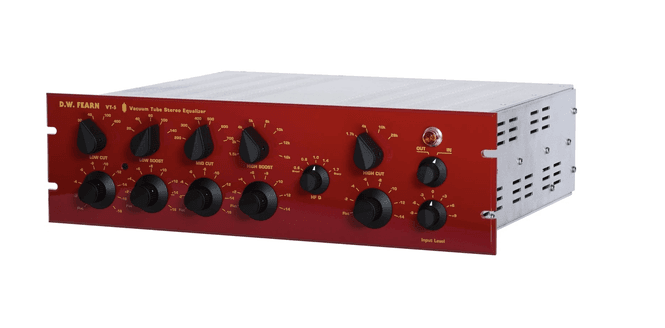
*Ta kontakt for tilbud! The D.W. Fearn VT-5 Stereo Vacuum Tube Equalizer is a dual-channel version of the acclaimed VT-4, offering a wide range of sonic control for stereo sources. Whether it be subtle fine-tuning or more aggressive transformations, the VT-5 gives you exactly what you need to bring your sonic ambitions to life. PREMIUM COMPONENTS Loaded with Class A triode vacuum tube stages for the input and output, the VT-5’s passive LC circuitry is derived from the VT-1 VT-2 mic preamp designs. Like those preamps, the VT-5 also uses custom-made Jensen transformers to boost and balance signals as low as -10dB. The result is a flexible sonic profile that’s smooth, sweet, and never harsh even at more aggressive levels. VERSATILE FREQUENCY CONTROL The VT-5 sports an intuitive control scheme featuring tactile, vintage-style rotary switches with 1% metal-film resistors. Most notably, the range and shape of the frequencies and curves were determined by ear via extensive hours of listening and fine-tuning, making for an exceptionally musical equalizer that will effortlessly bring out the best qualities of your signal. The D.W. Fearn VT-5 Stereo Vacuum Tube Equalizer is a dual-channel version of the acclaimed VT-4, offering a wide range of sonic control for stereo sources. Whether it be subtle fine-tuning or more aggressive transformations, the VT-5 gives you exactly what you need to bring your sonic ambitions to life. PREMIUM COMPONENTS Loaded with Class A triode vacuum tube stages for the input and output, the VT-5’s passive LC circuitry is derived from the VT-1 VT-2 mic preamp designs. Like those preamps, the VT-5 also uses custom-made Jensen transformers to boost and balance signals as low as -10dB. The result is a flexible sonic profile that’s smooth, sweet, and never harsh even at more aggressive levels. VERSATILE FREQUENCY CONTROL The VT-5 sports an intuitive control scheme featuring tactile, vintage-style rotary switches with 1% metal-film resistors. Most notably, the range and shape of the frequencies and curves were determined by ear via extensive hours of listening and fine-tuning, making for an exceptionally musical equalizer that will effortlessly bring out the best qualities of your signal. MADE FOR EVERYTHING, BUILT FOR ANYTHING Built with sturdy heavy-gauge aluminum, each VT-5 unit is carefully stepped and tested for seamless matching between units. Whether you’re working with acoustic or electric instruments, specific tracks, or entire mixes, the VT-5 will deliver precise and satisfying coloring to your sound. FEATURES: Frequency response: ±0.2 dB 20 Hz to 20 kHz THD: less than 0.06% Signal-to-Noise: better than 80 dB Low Cut at 30, 40, 100, or 400 Hz, 0 to -18 dB shelving in 2 dB steps Low Boost at 20, 40, 60, or 140 Hz, 0 to 16 dB shelving in 2 dB steps Mid Cut at 200, 300, 400, 500, 600, or 700 Hz, 0 to -16 dB in 2 dB steps High Boost at 1.5, 3, 4, 5, 8, 10, 12, or 16 kHz, 0 to 12 dB in 2 dB steps High Bandwidth Q of 0.6, 0.8, 1.0, 1.4, or 1.7 High Frequency Cut at 1.5, 3.5, 8, or 28 kHz, 0 to -14 dB shelving in 2 dB steps Gain adjustable from -9 to +9 dB, referenced to +4 dBm, in 3 dB steps   MADE FOR EVERYTHING, BUILT FOR ANYTHING Built with sturdy heavy-gauge aluminum, each VT-5 unit is carefully stepped and tested for seamless matching between units. Whether you’re working with acoustic or electric instruments, specific tracks, or entire mixes, the VT-5 will deliver precise and satisfying coloring to your sound. FEATURES: Frequency response: ±0.2 dB 20 Hz to 20 kHz THD: less than 0.06% Signal-to-Noise: better than 80 dB Low Cut at 30, 40, 100, or 400 Hz, 0 to -18 dB shelving in 2 dB steps Low Boost at 20, 40, 60, or 140 Hz, 0 to 16 dB shelving in 2 dB steps Mid Cut at 200, 300, 400, 500, 600, or 700 Hz, 0 to -16 dB in 2 dB steps High Boost at 1.5, 3, 4, 5, 8, 10, 12, or 16 kHz, 0 to 12 dB in 2 dB steps High Bandwidth Q of 0.6, 0.8, 1.0, 1.4, or 1.7 High Frequency Cut at 1.5, 3.5, 8, or 28 kHz, 0 to -14 dB shelving in 2 dB steps Gain adjustable from -9 to +9 dB, referenced to +4 dBm, in 3 dB steps
Emperical Labs EL8S ...

37.995,-

40.995,-

Ta kontakt for tilbud! DISTRESSOR Product Description The Distressor is an automatic gain (or volume) control device (AGC in engineering terms) designed for pro audio (music) applications. Basically, it electronically controls the volume of just about any source in a very pleasing, and "musical" manner - adding fullness, intelligibility, and especially in the Distressor's case - excitement. This type of device is often called a "limiter" or "compressor" by audio industry people. Its most probable uses will be in recording studios, live sound situations, movie sound production, and radio broadcast production.     Unlike most analog compressor/limiters the Distressor is a digitally controlled audio device and actually incorporates several products into one by utilizing digital controls to switch totally different circuits in and out. Years of beta testing and redesign went into the Distressor as will be the case with all Empirical Labs products.     Besides offering a wide range of control and unique features, the Distressor offers a warm, vintage sound by using a custom designed gain control circuit. This "warmth" or vintage sound has become an important issue in the last 15 years, as the super clear and linear digital technology does very little (or nothing) to soften "harsh" sounds nor emphasize the bass frequencies in music sources. Older analog tape, vinyl records and tube equipment on the other hand, could not be prevented from coloring the sound, often to the frustration of recording engineers. However, many people have now realized that this coloring can be extremely pleasant and "musical".The current digital technology is often referred to as "cold" and "brittle" among other terms, although we prefer the term "unforgiving" to describe the negative side of the "linearity". The Distressor offers several modes that color the signal, even without compression (or gain control). These extended modes were designed to allow emulation of some very old and some very expensive vintage gain control units (compressors & limiters) and deliver a classic "knee" sound all its own.     Specifications:     * Freq. response is 2 Hz to 160 kHz in clean audio mode (+0, -3 dB). Response is shaped in distortion modes (Dist 2, Dist 3).     * Dynamic range 110 dB from max. output to min. output in 1:1 mode. Greater than 100 dB signal to noise in distort 3 mode.     * Distortion ranges between .02% and 20% depending on distortion mode and release times set on front panel.     * DC coupled output - High quality input caps.     * Input impedance is 20K Ohms, Output impedance is < 75 ohms     * Time constants - Attack range 50uS - 50mS. Release range .05 sec to 3.5 seconds, normal modes and up to 20 seconds in 10:1 opto mode. Time constants are dependant on ratio.     * Metal Chassis - single height 1.75" high, 10" deep, 19" wide.     * Shipping info - 12.1 lbs mono, 24.2 lbs Stereo pair. Mono box dimensions 22.5" x 18.5" x 3 1/4". Stereo Pair box dimensions 22.5" x 18.5" x 6 1/4  
Golden Age Premier EQ-73 ...

5.195,-

5.795,-

The class-A circuit used in the EQ-73 PREMIER is similar to the eq section in the classical 1073 module, without the high pass filter. Additional frequencies have been added and the mid frequency band uses two inductors, the higher value of the second one is used for the two lowest frequencies, 160 Hz and 240 Hz, to achieve an optimal response. The sound character is warm, punchy, sweet and musical. These classic characteristics have been heard on countless recordings through the years and it is a versatile sound that works very well on most sound sources and in most genres. The essence of this sound is now available at a surprisingly low cost, making it available to nearly everyone. The EQ-73 PREMIER has stepped frequency controls that offers a wide selection of frequencies from 20 Hz to 24 kHz. The low and high frequency bands are shelving and the mid frequency band is of the bell type. The control range is +/-15 dB for the two lower bands and +/- 18dB for the high frequency band. There are separate bypass switches for all three bands. The EQ-73 PREMIER can be used either as a standalone EQ or connected to the insert jack of one of the Golden Age Premier or Project preamps. Combining one of our PRE-73 preamp´s and an EQ-73 PREMIER and using a UNITE rack kit to mount them together, one will get a 19-inch 1073-style unit at a low cost and with a great sound! FEATURES – Vintage style electronics. No integrated circuits in the main signal path – 3-band with a dual inductor based mid frequency band and stepped frequency selection – A wide selection of frequencies from 20 Hz to 24 kHz and a control range of up to +/- 18 dB – Separate bypass switches for each band – Two UK made Carnhill inductors in the midrange section – Tantalum capacitors in the main signal path, polystyrene capacitors in the gain stages – Burr Brown OPA 2602 IC used for the balanced output stage – Soldered internal connections – Can be used together with one of our preamp´s with an insert jack or as a standalone unit – TRS jack for the INSERT mode in- and output connection, the nominal working level is around -18 dBu – IC-based in- and output stage for the LINE IN mode with balanced TRS and XLR connectors – Selectable ground lift jumper – External power supply to avoid interaction with the audio circuits
Harrison 500-series Mixer ...

8.495,-

8.995,-

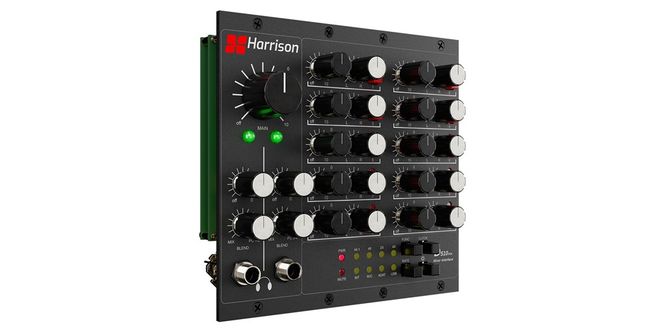
  Harrison D510mx Analog Summing Mixer(500 Chassis not included). Build your custom 500 Series analog mixer Pair the D510r with the optional D510mx mixer module to transform your system into a powerful 10x2 analog summing mixer. Designed to integrate into two slots of the Harrison D510r 500 Series rack, the D510mx gives you the flexibility to create stereo mixdowns from any of the eight remaining 500 Series module slots, alongside the two analog inputs to slots 9 and 10. With level and pan controls on each channel, plus dual independent headphone outputs with ‘blend,’ get the renowned weight and ‘3D’ depth that Harrison analog summing brings to productions while enhancing your headphone monitoring capabilities. When used in combination with the D510dante audio interface card, the dual headphone outputs can create monitor mixes from either the direct analog output or from any connected device on the Dante network. With an almost infinite number of configurations, the Harrison D510 rack paired with the D510mx mixer module can create an extremely powerful (and portable) eight-channel tracking system housed in only 3U – we said it was flexible! D510mx Specifications: D510mx Inputs Minimum Gain: <= -81 dB Noise A-Weighted @ Min Gain: < -87 dBu  Unity 0 dB THD+N, 1kHz 10 dBu @ Mid Gain: < 0.003% Noise A-Weighted @ No Gain: < -87 dBu Maximum Gain: 11.5 dB THD+N, 1kHz 0dBu @ Max Gain: < 0.003% Noise A-Weighted @ Maximum Gain: < -85 dBu  Maximum Input Level: +24 dBu Frequency Response: 20 Hz – 20 KHz +/- 0.25 dB Pan – 3dB Pan Law D510dante Inputs (when optional D510dane interface is installed)  Maximum Input Level: +24 dBu Frequency Response: 20 Hz – 20 KHz +/- 0.25 dB  Main Outputs Maximum Output Level - +24 dBu Minimum Gain: <= -85 dB Noise A-Weighted @ Min Gain: < -97 dBu Unity 0 dB THD+N, 1kHz 10 dBu @ Mid Gain: < 0.003% Noise A-Weighted @ No Gain: < -87 dBu Maximum Gain: 9.5 dB THD+N, 1kHz 10 dBu @ Max Gain: < 0.003% Noise A-Weighted @ Maximum Gain: < -78 dBu Headphone Outputs Maximum Output Level - +21 dBu Minimum Gain: <= -78 dB Noise A-Weighted @ Min Gain: < -87 dBu Maximum Gain: 0 dB THD+N, 1kHz 20 dBu @ Max Gain: < 0.004% Noise A-Weighted @ Maximum Gain: < -82 dBu Signal Metering 3x tri-colour LED signal presence Green: >= -14 dBu, + 4 dBu Orange: >= +4 dBu, +18 dBu Red: >= + 18 dBu Connectors TRS Stereo Headphone Output (2)
Radial WR8 RACK, 8-slot power ...

9.859,-

11.359,-

Ta kontakt for vår pris!• Description * 500 series power rack with room for 8 modules * Upgrades to full Workhorse with optional mixer * 100% compatible with older API type racks * Over 20% more current than the original spec The Workhorse WR-8 is a trimmed down version of the Tec Award winning Workhorse power rack without the 8 channel summing mixer. This enables those that may not need a mixer to join in the fun while leaving the door open to upgrade in the future. Like the Workhorse, the WR8 features eight slots to accommodate both Radial modules and other API Lunchbox™ compatible modules. An innovative slide-in tray makes loading modules easy! Rear connections include XLR and ¼" TRS inputs and outputs plus parallel connections via D-Subs. Unlike older API type racks that need to be hard patched, the WR8 features an innovative FEED switch that lets you connect modules in series by simply setting the switch to suit. This leaves the other connectors open for mult'ing, parallel processing and cross patching. Stereo-ready modules such as compressor-limiters no longer need to have inside traces soldered! A simple LINK switch performs the connection and lets you revert back to normal without de-soldering. Radial also upgraded the 500 series spec with Omniport, a ¼" TRS connector that enables the manufacturer to assign a special module-specific function to increase functionality. Radial modules employ the Omniport in a variety of ways. For instance, the PowerPre assigns the Omniport as an instrument input, the Komit is a key input for the side chain and the JDV-Pre uses it as a direct box output for stage use. The WR8 provides extra power to the modules for more headroom with over 1600 milliamps of shared power for the 8 slots. This enables you to use power hungry devices like tube preamps with confidence. The external supply makes international travel easy with 100V to 240V compatibility and the use of a standard IEC connector. To keep modules safe, the WR8 is equipped with protective circuitry to prevent mishap should improper connections be made. The WR8 power rack - All the power of a Workhorse without the mixer.
Raumzeitmaschine - Tube ...

29.995,-

31.995,-

    NB:Velg frakt "Frakt for Mikser,Monitor,Rør Mikrofon,Keyboard,etc."på disse 19" enhetene.De kommer i egen treeske,og veier en del.   Room processor Remote controllable by a DAW plugin.   What is the Raumzeitmaschine? The Raumzeitmaschine creates a spatial tone that sounds very natural, transparent and clear on the one hand, but on the other hand it has a nice sound on its very own. This is achieved through the unique combination of digital and analog components. There is of course a processor that calculates the reverb. This is enriched by the typical analog sound of our devices.   Unique operating concept The Raumzeitmaschine offers the most direct access to the right sound with only three parameters. Instead of plodding through hundreds of parameters (90 percent as non-programmers, not knowing what they're doing), now you can tune the sound to the way your mix needs it. An operating approach as with a real musical instrument. Presets in simple We have omitted the complicated preset management directly on the device. If you remember programming the timer on a VCR, then you know why. The Raumzeitmaschine is equipped with servomotors and thus controllable remotely by the DAW. Conversely, direct changes to the device also land immediately in the Raumzeitmaschine plug-in. Use the preset management of your DAW or the Raumzeitmaschine plugin.  It's as simple as that! Remote-controlled All controls of the Raumzeitmaschine are equipped with servomotors.  You can control it directly on the frontpanel, by the internal webserver or by the DAW plugin (AU, AAX, VST). Because the Raumzeitmaschine connects to your computer via Ethernet, there is no limit on cable length like using USB. Wireless via your router is also no problem.   Tubes? Yes, tubes! The Raumzeitmaschine has two double triodes per channel as well as input and output transformers. That's why there are only analog inputs and outputs, not digital ones. An important sound component would otherwise be missing without it. If you like it fatter, you can even try to override the tube from the input stage.   Not only 'Natural' sounds Although the goal was a natural surround sound, it is also possible to create unnatural sounds too. A storeroom with 3 seconds of decay time?  Easy.  Sounds unusual.  But can fix the mix.  Can be tried out within one second. How does it sound in comparison? Different to all the Lexi-TC-Event-Bri-Qs.  The Raumzeitmaschine will definitely not replace a plate or reverb spring. But it's unique sound is guaranteed to find its place as the main reverb in your setup. Listen for yourself and become enchanted.   FEATURES True stereo Input: XLR, transformer-balanced Output: XLR, transformer-balanced Reverb processor Adjustable Pre-delay, Room size, Density and Decay Time Ethernet Controllable by the webpage of the device or by plug-in (VST, AU, AAX) Servo pots Dynamic: >110dB unweighted Attenuation-to-crosstalk ratio L/R >90 dB @ 1 kHz Internal power supply (25W) Height: 88,1mm (2u), Width: 483mm, Depth: 250mm   SPECIFICATIONS Frequency Response: 10Hz - 22kHz Maximum Input Level: +22 dBu  Input Impedance: ≥ 10kΩ  Output Impedance: < 600 Ω  Maximum Output Level: +24 dBu  Dynamic Range: ≥ 110 dB  Voltage: 110- 240 V~/50-60 Hz  Fuse: 500mA slow-blow  Maximum Power Consumption: < 25 W  Dimensions: 2 U, H:88.1 mm, W:483 mm, D:250 mm
rocruepel comp.two(version 2)

50.990,-

61.250,-

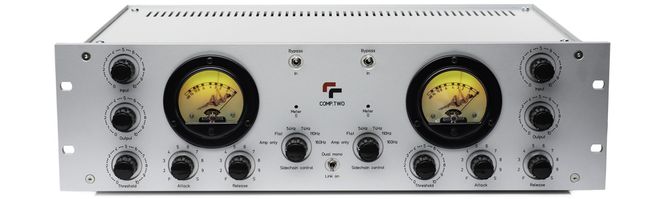
comp.two(version 2). The comp.two is built on fully-balanced tube-circuitry. The main audio path consists of SOWTER input- and output transformers (SOWTER), two high-end coupling capacitors, input- and output-tubes (NOS 6N3 and 6CG7). The „true“ dual mono-design has separate power supplies for every channel. The potentiometers are encapsulated, quality products from ALPS. The VU-meters can be calibrated with a trim-pot hidden behind small holes in the rugged front plate. All switches use relays or directly determine control voltage. The two bypass-switches separate circuitry, so that only input directly connects with the output (true bypass). An IC is used to regulate the VU-Meter. Apart from that circuitry, the comp.two consist of discrete components and is hand wired in Germany. In addition to the essential controls such as input, output, threshold, attack and release, the comp.two provides a side chain with an integrated four-stage filter. (Flat, 50, 74, 110 and 160 Hz). This filter takes out high-energy bass frequency that could otherwise affect the compressor’s behavior. The special “amp-only” -mode uses only the in- and output-stages and not the compression. Some may say: “Tube-compressors sound good but they are too slow. I prefer VCA-compressors because of their speed“. The comp.two accomplishes both, with an attack up to 600 µs it is extremely fast but it also has a soft and really musical knee compression for your sound processing.   • Audiophile, fully symmetrical design • Aluminium chassis with 6 millimeter front plate • SOWTER-transformer • ALPS-pots • VU-Meter (manual calibration) • Output tube : 6CG7 • Input tube : NOS 613P • WIMA-dual capacitor • Amp-Only-Mode • Real bypass • Dual Mono with separate power supply • Sidechain-Control (54, 74, 110, 160 Hz)
Viser 46 til 60 (av 386 produkter)
  • vipps-orange.png
  • klarna-dark.png
  • mastercard-full.png
  • visa.png